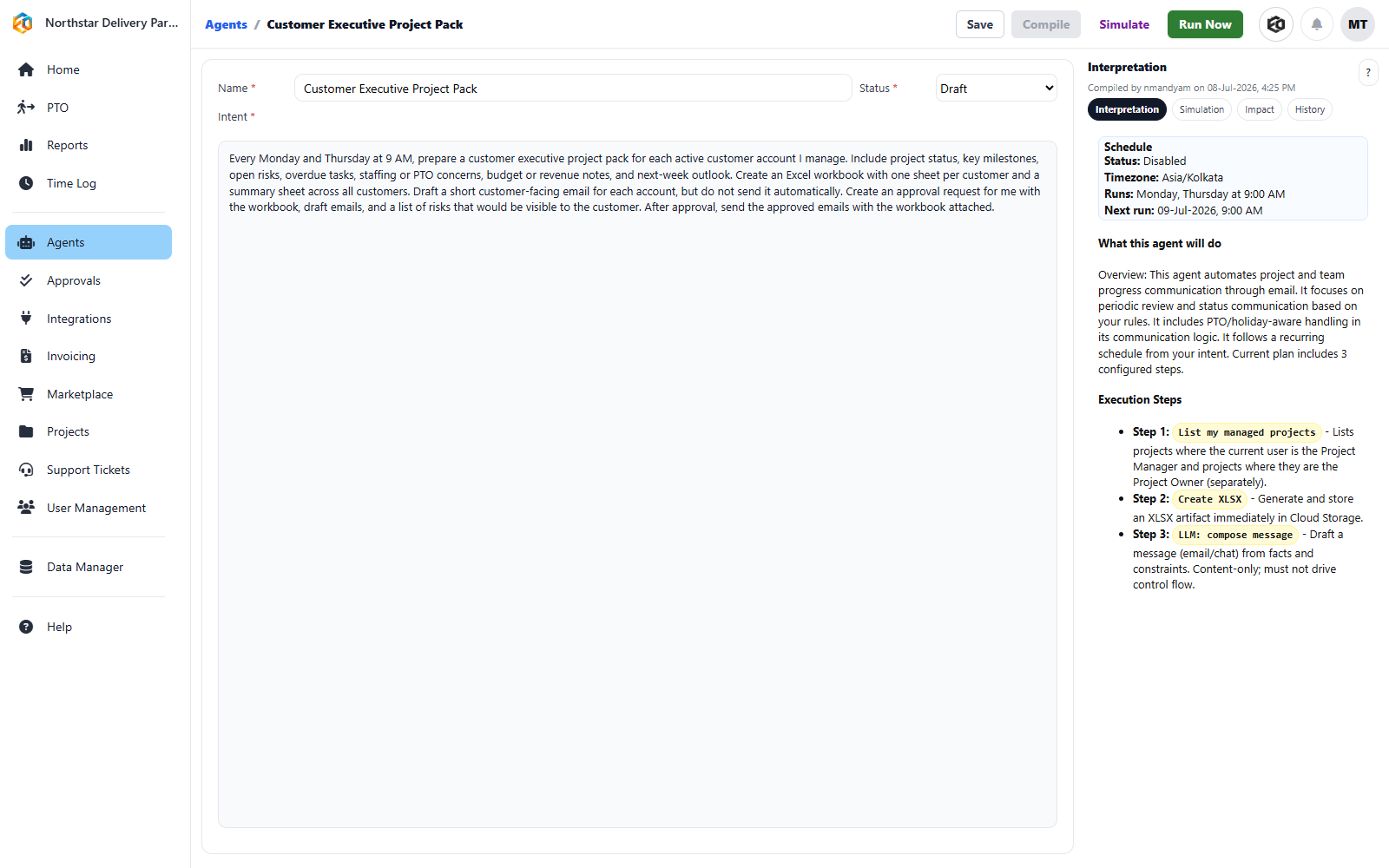
Eos is a strong fit for project-driven services organizations because it connects project execution, service requests, team coordination, time, billing, reporting, and automation in one system — while keeping workflow execution deterministic instead of unpredictable.
Projects live in one tool, tickets in another, time somewhere else, billing in another, and managers are left stitching together updates in spreadsheets and browser tabs.
A single operational system connects delivery, service work, follow-through, time, billing, reports, and workflow automation without sending teams back to engineering.
Services firms do not just manage tasks. They manage commitments, client communication, profitability, responsiveness, and the cost of operational chaos.
One of the most common services problems is simple and painful: leadership, HR, delivery managers, and sometimes clients all need updates, but the information is scattered and the output needs to vary by audience.
Replace this with a screenshot or graphic showing the workflow inputs on one side and outputs on the other: project data, task data, PTO data → Slack update, leadership email, Excel sheet for HR, Teams message, etc.
Project managers and operations leaders can describe the workflow they need in plain English, instead of translating the requirement into technical implementation steps.
The workflow does not improvise its way into trouble. Eos executes deterministically, so it behaves the same way each time unless you deliberately change it.
Projects, service requests, team context, time, billing, and reporting stay connected, so automation can act on real operational context.
Embed a 2–4 minute YouTube video here showing one concrete services workflow from prompt to execution to outputs.
We will show you how Eos would automate it — predictably — across the tools and teams you already use.