There’s a lot of excitement around “agents” right now. If you read the headlines, they sound almost magical...
There’s a lot of excitement around “agents” right now. If you read the headlines, they sound almost magical:
And to be fair, that’s not entirely wrong. But there’s another side to this story. A side that’s sometimes on acid.
At their core, autonomous agents are designed to:
You don’t define every step. You give them an objective: “Improve customer response times” or “Reduce overdue invoices”. And they figure out what to do. That’s really powerful.
Autonomous agents can:
They feel less like software, and more like a capable operator. In theory, this is where everything is headed.
That same autonomy comes with trade-offs.
Agents can slowly move away from what you intended. They start optimizing for something slightly different than your goal. Maybe because your goal was not clearly defined. Maybe because they did something else by mistake once and you were OK with that.
They may make decisions based on incorrect assumptions or invented context. This is a very real thing - AI does invent new DNA pathways. It also invents its own reality, sometimes.
They might take actions you didn’t expect:
Because you didn’t define the steps, you can’t always trace exactly what will happen. This is not a bug. It’s a side effect of autonomy.
Autonomous agents are clearly powerful. But they’re also still evolving. For some use cases, they’re perfect. For others—especially business-critical workflows—they can feel a bit… adventurous.
In Eos, agents are not autonomous in that sense. They are Workflows written in English. You describe what should happen:
And Eos turns that into execution using skills.
Eos agents are:
Eos agents do not:
They don’t go rogue—because they don’t have that kind of autonomy.
Let’s be honest: this is a trade-off. Compared to fully autonomous agents, Eos agents are:
But in return, you get:
For most operational workflows, that’s usually the better deal.
Yes. You could design an Eos agent that behaves more autonomously:
The platform can support it. But the real question is: Do you want to?
Autonomous agents are not a passing trend. They are the future. As models improve and controls get better:
And systems like Eos will evolve along with that.
Right now, you have a choice. Do you want:
A system that thinks for itself, with all the power—and unpredictability—that comes with it?
Or:
A system that does exactly what you said, every time?
Like Spiderman's Uncle Ben said (back in 1962!):
“With great power comes great responsibility.”
Autonomous agents definitely have the power. The responsibility part? That’s still a Wrok In Progress. So for now, the real question is:
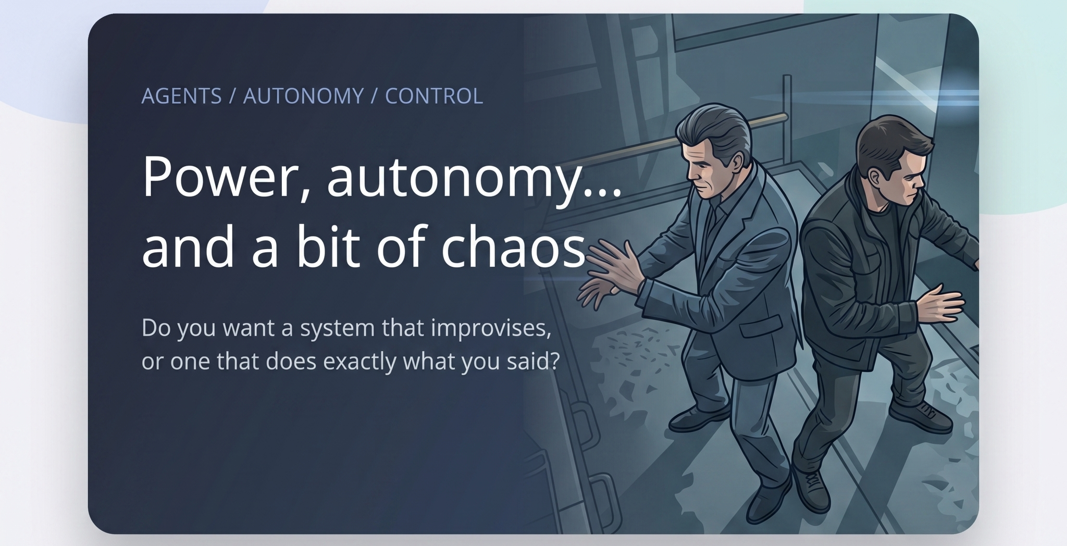
Do you want Bond? Or Bourne?🙂